Eclypse ESATS — Automated Avionics Test System Restoration
Troubleshooting, repair, and recommissioning of the Electrical Sub-Assembly Test Set supporting CH-53 and H-60 avionics.
Aerospace Electronics & Test Engineering
- Affiliation
- United States Marine Corps
- Classification
- Automated test equipment / fault isolation / system recommissioning
- Stage
- Completed engineering work
Restoring the instrument behind the test
I troubleshot, repaired, and recommissioned an Eclypse International Electrical Sub-Assembly Test Set (ESATS) used for automated testing of CH-53 and H-60 avionics. The station normally helped maintainers decide whether an aircraft assembly was functioning correctly. During this repair, the station itself was the equipment under investigation. That change in perspective raised a practical question that has stayed with me in subsequent instrumentation work. What gives a maintainer grounds to trust the result on the screen?
Maintenance context and objective
Fleet Readiness Center Southwest described ESATS in its 2010 Almanac as an instrument used to analyze avionics assemblies for the SH-60 Seahawk and CH-53 Super Stallion. That account documents how the Navy used this class of equipment. In my Marine Corps work, my responsibility was to recover an existing station so it could again support automated testing of aircraft components. 1
A test result can influence whether a serviceable assembly stays in use or is sent for further repair. An intermittent connection in the test interface, for example, can produce the same indication as an open connection inside the assembly. Repeating the test may reproduce the indication every time while leaving its origin unresolved. A useful investigation therefore asks which parts of the measurement path were common to each observation and which conditions actually changed between observations.
Functional architecture of ESATS automated testing
An automated electrical test connects a statement about expected behavior to a physical observation. The procedure identifies a connection and an electrical condition, the station applies that condition, and the measurement hardware acquires a response. Software then evaluates the response against the criterion for that test. Eclypse’s descriptions of its analyzers and test program sets explain the roles of the test definition and the adapter that connects a particular assembly. 2 · 3
| Function | Relationship between software and hardware |
|---|---|
| Command and stimulus | The controller executes the test program. Stimulus and switching resources establish the selected electrical condition. |
| Physical interface | The adapter carries the condition to the intended connection on the unit under test and provides a path for its response. |
| Acquisition and evaluation | A measurement resource acquires the response. Software associates the reading with the test step and evaluates it against its criterion. |
Conceptual architecture based on public manufacturer documentation. The table describes functional relationships. The photographed station’s internal wiring and installed configuration are unspecified.
There are two kinds of correspondence to preserve along this path. The electrical connection has to reach the intended point on the assembly. The reading returned from that point must also remain associated with the instruction that requested it. An accurate measurement taken at a different connection can be entirely plausible in magnitude. Its plausibility alone says little about whether it answers the original test question.
Troubleshooting and corrective repair
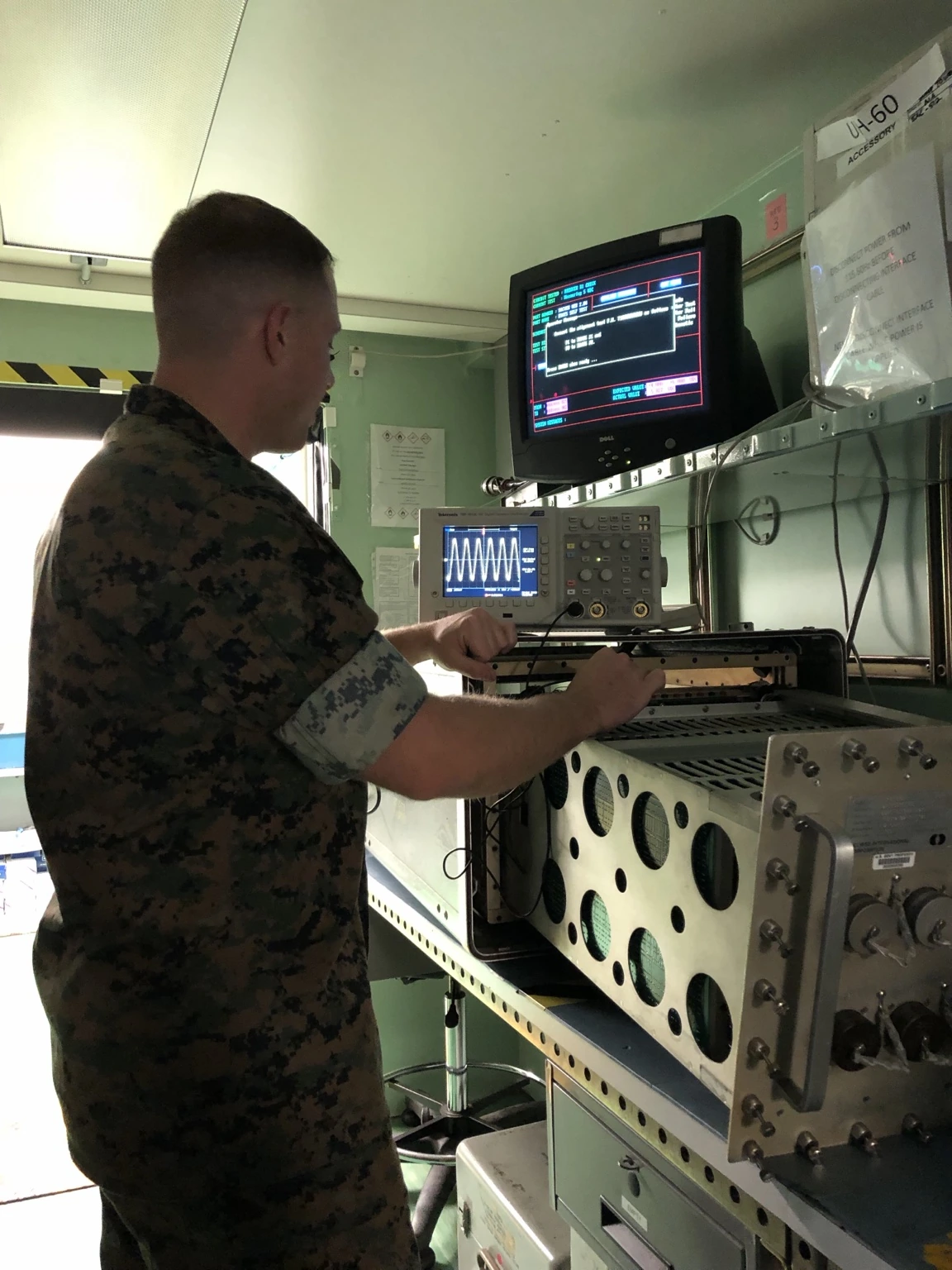
I investigated the station fault and carried out the repair. The photograph shows me at the open chassis with a bench oscilloscope displaying a waveform and a computer display above the work surface. Those instruments illustrate two perspectives on automated testing. The computer presents the procedure as the controller understands it. A bench instrument can provide an independent observation of electrical behavior at an accessible point.
The distribution of symptoms helps define a sensible boundary for investigation. A problem appearing across several otherwise independent tests warrants attention to the resources they share, such as a supply or measurement channel. A problem confined to one interface makes the adapter and its connections more informative places to investigate. Each pattern narrows the question. Neither establishes the identity of a failed component on its own.
Another distinction concerns the outward and return paths. An unexpected reading can arise because the intended stimulus never reached the assembly, because the assembly responded unexpectedly, or because acquisition failed to represent the response faithfully. An independent observation can distinguish some of those possibilities. Its value depends on where it was made and which portion of the path it actually verifies. These examples explain the diagnostic reasoning applicable to the equipment. The photograph records the repair work without identifying a particular failed card or measured signal value.
Software–instrumentation integration
Working on ESATS changed how I read an automated test result. I came to see the displayed decision as the end of a sequence of choices about addressing, switching, measurement, and interpretation. Eclypse’s ELITE documentation illustrates how software represents test instructions and limits. Its ID File Editor illustrates a complementary function, associating analyzer addresses with physical connector pins. Together they provide public examples of how a test environment gives electrical meaning to a software instruction. 4 · 5
Consider what a connector designation means to someone reading a drawing. It identifies a physical point they can locate. A controller needs a mapping to reach that same point through an adapter. A test program also needs to know what response has meaning there under the specified condition. Understanding those relationships helped me connect my experience troubleshooting individual circuits with the broader problem of evaluating an instrument that makes decisions about other equipment.
Recommissioning and return to service
After repair, I recommissioned the ESATS and returned its automated avionics test capability to operation. For a station of this kind, a normal startup can establish that the controller is responsive. Functional verification addresses a different question, whether the controller, electrical resources, and physical interface work together through an applicable test. This account documents the station’s return to operation. A calibration finding would require its own measurement records and acceptance criteria.
The lasting value of this work was learning to follow a maintenance decision back to the observation on which it depends. That perspective also informs my original test-equipment designs. Choosing what a technician can command, where a response can be observed, and how that response will be interpreted is part of designing a usable instrument.
References
- Fleet Readiness Center Southwest. Almanac, vol. 3, no. 5, January–February 2010, pp. 14–15.
- Eclypse International. Ruggedized Test Systems.
- Eclypse International. Test Program Set Development.
- Eclypse International. ELITE Test Software.
- Eclypse International. ID File Editor.
Technical areas
Automated test equipment, avionics, electrical troubleshooting, instrumentation, stimulus and measurement, hardware/software interfaces, recommissioning, functional verification.
MV-22 emergency egress lighting test set and battery analyzer →